

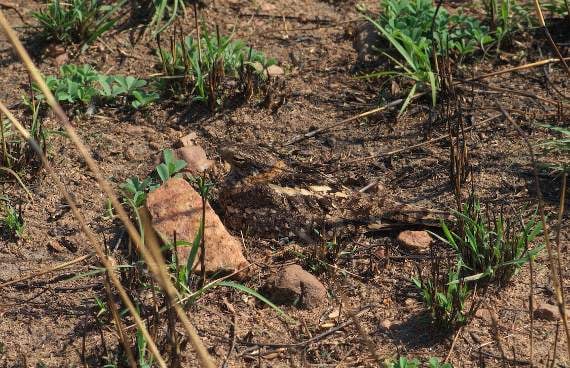
Animals that rely on camouflage can choose the best places to conceal themselves based on their individual appearance, new research shows.
The camouflage and concealment strategies of various animal species have been widely studied, but scientists from Exeter and Cambridge universities have discovered individual wild birds adjust their choices of where to nest based on their specific patterns and colours.
The study looked at nine remarkably hard-to-see ground-nesting bird species (nightjars, plovers and coursers).
‘Each individual bird looks a little bit different, and we have shown that they can act individually,’ said project co-leader Professor Martin Stevens, of the Centre for Ecology and Conservation on Exeter’s Penryn Campus in Cornwall.




‘This is not a species-level choice.
‘Individual birds consistently sit in places that enhance their own unique markings, both within a habitat, and at a fine scale with regards to specific background sites.’
The study, carried out in Zambia, showed individual birds chose backgrounds that enhanced their camouflage to the visual systems of their main predators – being better matched to their chosen backgrounds than to other places nearby.
The researchers say it is not yet clear how individuals choose places to suit their appearance.
Project co-leader Professor Claire Spottiswoode, of the University of Cape Town and the University of Cambridge, added: ‘We tend to think about camouflage as something that involves gradual evolutionary change in appearance – we don’t often think of it as a matter of individual animal behaviour. This research helps us understand how behaviour and appearance are linked.’
The paper is published in the journal Nature Ecology and Evolution.
Comments
This article has no comments yet. Be the first to leave a comment.