
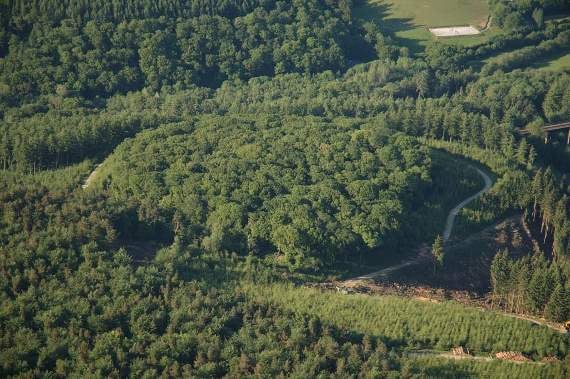
An ancient hillfort in Cornwall and part of the 16th Century sea defences at Devonport are among the fascinating and special places now on Historic England’s protected list.
Largin Castle, overlooking the Glynn Valley in East Cornwall, is now a scheduled monument.
This impressive hillfort may be able to tell us more about the story of prehistoric life in Cornwall, says Historic England.
Located on a steep-sided promontory overlooking the Glynn Valley, Largin Castle is thought to date to the Iron Age (900-100 BC).?




Its impressive triple ramparts and ditches are well-preserved and surround an oval central enclosure.
Evidence of a trackway, possibly medieval, running through the earthwork, suggests that it was used for cultivation during that period.
The construction of the Great Western Railway through Cornwall in the mid-19th century cut close to the north-west corner of the hillfort, but didn’t damage it.?
The remains of Largin Castle have the potential to contribute to our knowledge and understanding of the area during the prehistoric period.
Meanwhile, Wilkinson’s Battery at Devonport has been given Grade II Listed status.
The structure is part of the coastal defences constructed by Sir Francis Drake from 1590 onwards in response to a threat of sea-attack by the Spanish on Plymouth.
An artillery fort was built on the eastern part of Plymouth Hoe, protecting the entrance to Cattewater and the harbour in Sutton Pool. This later became known as Drake’s Fort.
It is thought that Wilkinson’s Battery was built around this time as a blockhouse, and was in place in 1595 when it was incorporated into the lower part of Drake’s Fort (now the Citadel, a scheduled monument).
The Battery was partially demolished and rebuilt in around 1888.?
Built from local Devon limestone and granite, it retains its expressive defensive form, despite some alterations, including those made during the Second World War when the battery was used as an air-raid post.
The top of the battery is today used as a viewing platform.
Other buildings in Devon and Cornwall that have been listed are The Palais de Danse in St Ives, used as a studio by the artist Barbara Hepworth, and The Passmore Edwards Library in Redruth, Cornwall, a characterful example of the work of Redruth’s principal 19th century architect James Hicks (both listed at Grade II).
Rebecca Barrett, Regional Director at Historic England in the South West said: “Every year, Historic England works to protect the most significant historic sites across the country.
“Despite the challenges that the heritage sector has faced this year, 2020 has seen many brilliant additions and revisions to the List.
“From Largin Castle in Cornwall to Swindon’s pioneering Health Hydro, we want to ensure the South West’s rich and varied cultural heritage is preserved so that the public can continue to cherish the heritage that makes their local places so special.”
If you’re looking for an outdoor activity, why not explore and find out more about the listed buildings and places in your local area? Just type in your postcode and an interactive map will show what’s nearby.
Historic England is also inviting you to ‘Enrich the List’ with your photos, drawings and knowledge of England’s spectacular historic places.
Your contributions will be added to the National Heritage List which has?more than 400,000 entries from tower blocks and tombstones to palaces and pigsties, castles and cathedrals.
You don’t need to be an expert to enrich the List. Welcome additions might include children’s drawings or a budding photographer’s images.
Visit historicengland.org.uk/listing/the-list