
ONE of the joys of my job is that I get the opportunity to speak with our readers about what’s happening in their areas, the things they’re concerned about, and what I can do to shine a light on these matters.
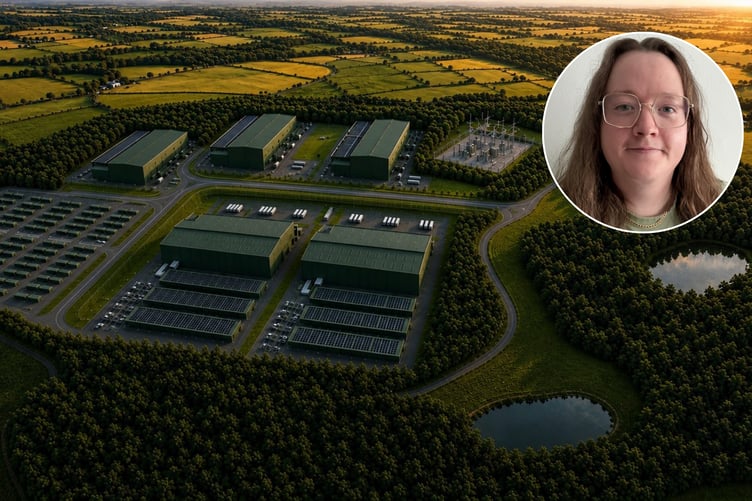
In recent months, one of the headline news stories has been proposals which would see an AI Data Centre plonked into the middle of the South West countryside, only a few miles from a small town, as part of a development which would stretch over 850-acres.
As a writer I know that digesting words on a page and trying to attribute real-world value to them can be incredibly difficult, so an arbitrary number such as 850-acres can mean very little. For those who might need help understanding such a scale, 850-acres equates to somewhere around 560 football pitches, 12,750 tennis courts, or just over one Central Park.
All of that space being used to house GPUs, TPUs, and high-performance processors, to process the demands of AI workloads from across the world.
The £13-billion plans have been proposed by British ‘renewable-energy’ organisation Xlink, the same company which attempted to lay an undersea power cable from the UK to Morocco.
Naturally, residents are concerned about why such a facility is needed, why this location has been chosen, and what it might mean for the area, and rightly so, why should a patch of undisturbed natural land be used to house a huge industrial development?
However, one day as I was reading one of these emails, my screen was filled by colourful icon which had popped up to ask if I’d like contents of the message to be summarised by an inbuilt AI system - an irony that isn’t lost on me.
A shiny little button just waiting to be pressed, yearning to ease me of my arduous task and allow me to take my eyes out of my head, pop them on the table for a rest while it takes care of everything.
Though presumably in this case, ‘taking care of everything’ involves taking the information from my email, whisking it halfway across the world to a data centre, allowing it to be processed and digested by a series of expensive computers, before beaming it back to me in a format containing fewer words.
Until this point, I’d never considered that simply reading an email may be something which required assistance, I viewed it much the same way I had sneezing, a necessary task which may sometimes take a couple goes but didn’t need someone to tickle my nose or hold the tissue in order to make it easier.




However, whether I view it as a necessity or not, it would appear that AI companies want to make you feel as though they are needed, something which we could never have lived without, there to make your life easier, much the same way the robots in Wall-E do.
Suddenly, I’m told all these tasks which I previously could have carried out on my own, require AI to hold my hand like some kind of omniscient metallic mother.
Want to design a poster? Use AI. Want to edit a picture? Use AI. Want a less-than optimal summary on an incredibly complex topic which researchers have been pouring over for years? Use AI.
So, if these tools are adamant on crowbarring their way into our lives, why wouldn’t I just use them? After all, they’re meant to make life easier, aren’t they?
When this forceful entry first began, my distaste for Artificial Intelligence - and the human intelligence behind it, was far less extreme. Tools were largely magic tricks which saw computers effectively Google what you’d ask them and return you an answer in a conversational manner in an effort to make you feel like you were actually ‘asking Jeeves’ and like you’d wished you were in the early noughties.
However, a few years on and things have developed as such a rate that every man and his dog seem to think that AI is the answer to their woes.
Scrolling through social media, it has become impossible to avoid the presence of AI tools. Posters for events all looking the same, with their yellow tinge, cartoony style and depictions of people which teeter on the edge of the uncanny valley.
Businesses adorn their pages with profile pictures boldly branding their names, with makeshift logos which have been generated by computers scouring the internet for similar designs that can be pinched.
Even people resorting to AI to ask if their local supermarket is open, despite reputable news outlets reporting that it closed down years prior.
These systems have stolen free thought and creativity, resulting in misinformation and indistinguishable personal and business identity.
If this wasn’t bad enough, the environmental impact of AI tools is said to be catastrophic. Data centres used to power every question, every picture request, and every text generation, have become infamous for their use of fresh water – something which is used in the cooling process, allowing the site’s hardware to keep running at all times.
Writing for the Environmental and Energy Study Institute, Miguel Yañez-Barnuevo, explains: “A medium-sized data centre can consume up to roughly 110-million gallons of water per year for cooling purposes, equivalent to the annual water usage of approximately 1,000 households. Larger data centres can each “drink” up to 5-million gallons per day, or about 1.8-billion annually, usage equivalent to a town of 10,000 to 50,000 people.”
Despite this, people continue to use these tools.
Those who are questioning why the countryside is being targeted as a potential location for giant processing plants, whirring away day and night to generate their very own profile picture of them and their dog in a cartoon style. The people who post a call to arms, urging people to stand up against such a development, using words which Chat GPT generated for them only moments ago, and local businesses concerned that such a building might turn customers away following their recent rebrand drawn for them by Claude AI.
I accept that it is everyone’s individual choice as to whether they use, or how they use AI, however, if a billion-pound corporation comes to town to propose the construction of a new facility to support your AI usage, can we really complain?
Comments
We've recently changed our login process. If you have an account for commenting, you will need to re-register on the login window.
This article has no comments yet. Be the first to leave a comment.