
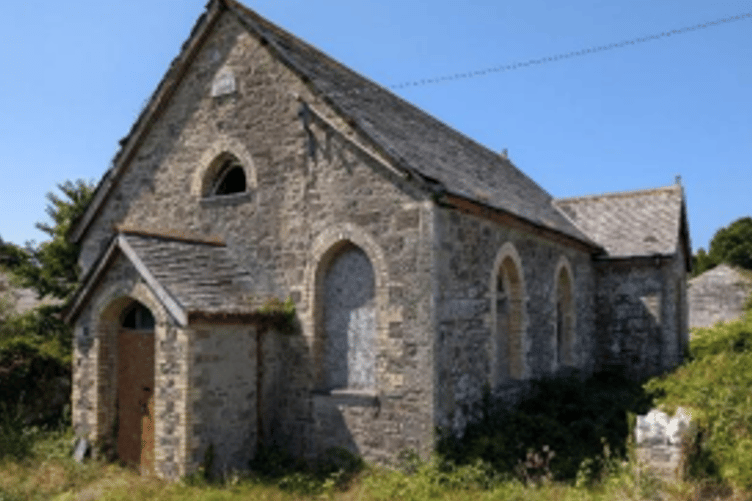
PLANS for a derelict former church in a North Cornwall village could see it saved with a future dwelling if concerns over highways and residential amenity are overcome.
That is the verdict of the Cornwall Council planning department in advice given to the present owner of the former chapel at St Kew Highway.
The former chapel at St Kew Highway was closed and deconsecrated by the Methodist circuit in the 1990s.
It was later stripped of its ecclesiastical fixtures and fittings, including pews, pulpit and organ prior to being sold.
After its sale, it had briefly become a light industrial workshop before commercial use ceased in the early 2000s, after which it became vacant and derelict for over two decades.
The applicant, Mr Warren Jones wishes to restore the building to serve as a home for himself and sought Cornwall Council’s advice on whether a future planning application might be approved and what it would require to maximise the chances of this being achieved.
The council told the applicant that proposals to incorporate car parking and access to the location directly on the junction to the A39 are critical to any future planning application.
Only one of the five potential options suggested were supported by the Cornwall Council highways officer, with proposals involving a turntable where the car is manually turned around so it can leave the site in a forward gear all being rejected on the potential for risk.
The Cornwall Council planning officer concluded: “It is my opinion that subject to the submission of sufficient supporting information to demonstrate that the building is structurally sound, capable of conversion, and that the extent of works would not amount to substantial rebuilding, there may be scope in principle for the conversion of the existing building to a single residential dwelling.
“The building's age, traditional construction and historic character suggest that it could be worthy of retention and is likely to be considered a non-designated heritage asset.




“Accordingly, it would be essential that any future scheme is informed by, and led by, the preservation and, where appropriate, enhancement of the building and its setting. A robust Heritage Impact Assessment should therefore clearly establish the significance of the building and demonstrate how the proposed works would impact upon that significance.
“The proposal is also subject to a number of key material planning considerations, including, but not limited to, heritage, landscape, ecology and residential amenity. It will be important that any future scheme adequately addresses these matters and demonstrates that the proposal would result in a high-quality, well-designed and sustainable form of development.
“Highways impact represents a notable concern in relation to this scheme and I would draw your attention to the detailed comments above which include the assessment of the Council's Highways Officer.
“It is vital that safe and suitable access for all users is demonstrated through a robust report prepared by a highways consultant. If a future application is submitted for the development, it would be crucial that all previously mentioned assessments and information are provided alongside this, as well as a full set of both existing and proposed plans.
Find out about planning applications that affect you by visiting the Public Notice Portal.
“Please note that the application is not necessarily limited to the information mentioned, however this will be necessary in any submission.”
Comments
We've recently changed our login process. If you have an account for commenting, you will need to re-register on the login window.
This article has no comments yet. Be the first to leave a comment.