
EACH week, hundreds of planning applications come before Cornwall Council’s planning department, seeking to win approval for various plans right across the Duchy.
These plans can comprise of a number of different reasonings – ranging from permission to replace windows or listed building consent ranging up to large house building developments or changing of use of a building, for instance, from an office to a café, or flats.
Within this large and often complex system, there are a number of formats from which planning advice and approval can be sought.
These range from full applications where all the details which comprise a proposed development or work to a building are submitted, to outline applications, where further details are yet to be confirmed, for example, an outline application with reserved matters for appearance may not confirm the final proposed development but rather seek permission in principle.



An example of this is one for an outline permission for 20 dwellings on land with reserved matters for appearance and scale; the reserved matters would require further permission later for their inclusion.
Other types of applications include pre-application advice requests, where would-be developers submit often outline proposals to a local authority to ascertain whether it is likely to gain support or not prior to submitting a planning application.
The vast majority of applications are decided by planning officers employed by a local authority under ‘delegated powers’, meaning they do so on behalf of their employer, however, some applications are ‘called in’ by local councillors to be discussed at an area’s strategic planning committee meeting, meaning the final decision rests with a committee of councillors.
Go ahead for holiday village plans
PROPOSALS for the redevelopment of a beach resort in South East Cornwall has been granted approval by Cornwall Council.
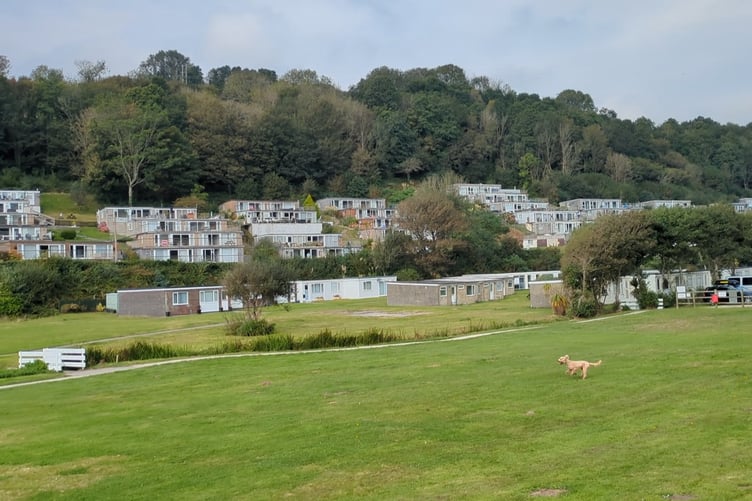
The application, which concerns Millendreath Holiday Village in Millendreath, Looe would see an extensive redevelopment of the existing site.
The applicants were seeking the council’s approval to create a new flood alleviation channel, replace 103 units of holiday accommodation (existing and extant) and add another 87 units of holiday accommodation at the site.
There would also be the construction of a restaurant building, a central facilities building, a tennis court, a car parking area, passing places, a re-alignment of the coastal path, hard and soft landscaping, fixed surface infrastructure and other associated works which would incorporate a replacement sea wall.
Looe Town Council said it was supporting the plans in principle subject to its concerns being addressed, stating: “The application title implies that the SWCP is to be realigned, but the submitted plans do not show how the route will be managed within the site. Looe Town Council would support retention of the path’s current route alongside the seawall at the top of the beach. Any diversion, for example, through the proposed car parking area, could reduce the SWCP’s amenity value and create potential conflict with vehicle movements.
“The existing seawalls incorporate two rows of WW2 “dragon’s teeth” anti-tank obstacles, whose distinctive forms remain clearly visible. These features are of cultural and historical significance to Millendreath and the wider Cornish coast. A heritage assessment, together with proposals for their protection, would therefore be welcomed. Currently, the application is short of detail on how the development relates to the SWCP, the beach and the seafront. To ensure there are no unexpected and unwanted outcomes it is prudent to clarify and agree these matters before any decision is made to allow the project to proceed.”
Cornwall Council approved the proposal subject to a number of conditions.
Explaining the reasons behind it, an accompanying officers report stated: “Millendreath is located in a secluded, wooded, steep sided, flat-bottomed valley, which opens into a south facing private beach where it meets the sea. The beach and elevated part of the site provide spectacular sea views towards St Georges (Looe) Island.
“Millendreath grew in the 1950s and 60s as a holiday resort with restaurant, cabins, caravans and recreational facilities. A number of private residential dwellings are situated on the eastern side of the valley. There are a number of on-site facilities in situ Page 96 of 112 including a restaurant and bar, as well as a sea pool.
“There is also a flood wall at the front, and this includes access to the private beach. The Beach Resort has a number of different types of accommodation blocks of a 1960 style design, being finished in white painted render and pebbledash. A number of units have undergone refurbishment and external cosmetic improvement however a large number of units are in need of enhancement due to flood damage throughout the last ten years rendering these units unlettable. The revitalisation of these units and the removal of flood risk on site is a key element of the Proposed Development.
“The site is not located within or near to the National Landscape - Area of Outstanding Natural Beauty (AONB). This site and much wider area of the Parish are situated within an Area of Great Landscape Value. The woodland to the northern half of the site (within the red line application boundary) is a designated County Wildlife Site (part of a wider Bodigga Cliff designation along the coastline).
“The woodland is designated as a Biodiversity Action Plan woodland. The specific area of this application is not covered by a Tree Preservation Order (either individual trees or area wide). There are no ancient trees within the woodland. It should be noted that the planning history for Millendreath Beach Resort is extensive and spans a 70 year period approximately.
“There exists a clear fall-back position in regard to the Hillside and Beachfront where a considerable quantum of built form is extant and could be built today without restriction. Both factors are material considerations when making an assessment on this Proposed Development within the planning balance.
“In regard to the Spinney and Seahorses, the former of which has a prior unimplemented planning permission for a dwelling and the latter previously contained holiday chalets should similarly be treated in the same way.
The economic, social and environmental benefits associated with the provision of new upgraded accommodation and facilities in reasonably close proximity to a settlement weigh heavily in favour of this application in the overall planning balance.
Seeking to extend the holiday village into existing woodland (Part of which is designated a Biodiversity Action Plan designation) is assessed to cause harm and weighs against the application in the overall planning balance. The proposal is assessed as appropriate in scale for its location making best use of the application site including land subject of lawfully extant permissions.
The proposed employment opportunities generated by this development could be significant for the local economy in terms of the construction period and post occupation management and local supply chain…Having given due regard to all matters, it is considered that the adverse impacts of granting permission would not significantly and demonstrably outweigh the totality of the benefits outlined above and the proposal represents sustainable development.
“All matters have been taken into consideration and where impacts are not fully mitigated through the imposition of conditions set out below, they are not of such weight as to tip the balance of considerations away from approval.”
Find out about planning applications that affect you by visiting the Public Notice Portal.
The documents and plans can be viewed using reference PA25/03028.
Comments
We've recently changed our login process. If you have an account for commenting, you will need to re-register on the login window.
This article has no comments yet. Be the first to leave a comment.