

IN the shadow of Truro Cathedral, men and women from backgrounds including teaching and the fire service are discussing how to respond when they encounter violence against women and girls (VAWG) in everyday life.
The conversation begins with the attitudes from which violence can grow: banter dismissed as “harmless”, but which may be corrosive and form the first step on a pathway towards more serious offending. Participants also explore why bystanders may hesitate to act, from fear of being hurt to a reluctance to stand out from the crowd.
Course leader Rachel Jones, training and development lead at emotional trauma and therapy specialists CLEAR, suggests gentle ways to intervene from a position of curiosity: “Why do you think that? Is there something you’d like to say?” Sometimes, she says, the right response is simply to call the police rather than assume somebody else already has.
This is a Champion workshop for the Male Ally Network (MAN), a Cornwall-wide programme launched in June to challenge the attitudes and behaviours that enable gender-based violence and help create safer communities for everyone.
The programme has three stages: an online toolkit answering practical questions about acting as an engaged member of the community; a two-hour online Ally session that builds bystander awareness and confidence to step in; and finally, a four-hour, in-person Champion workshop preparing participants to take the message into their communities.
Funded by Devon and Cornwall Police using cash from the Proceeds of Crime Act – including £50,000 seized from misogynist digital influencers Andrew Tate and his brother Tristan, no less – its partners include the High Sheriff of Cornwall, West Cornwall Women’s Aid, Women’s Centre Cornwall, Cornwall Council, Barnardos, Voluntary Sector Cornwall and even the Cornish Pirates rugby club.
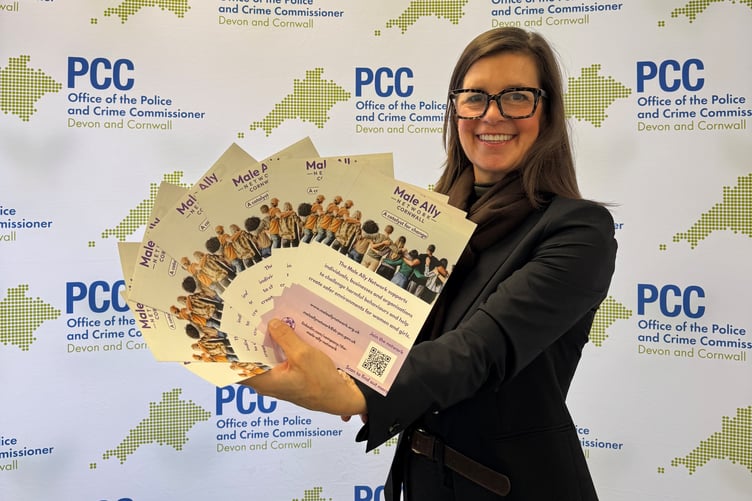
Project lead is Alexis Bowater OBE, a familiar face from her time at the helm of ITV Westcountry’s news bulletin. She was set on the path of campaigning for women’s safety following her own experience with stalkers, one of whom was imprisoned for four years. Thanks to her work, stalking was included in The Istanbul Convention to combat VAWG, new stalking laws were brought into force to protect UK victims, and Stalking Protection Orders were made law in 2020.
Alexis received the OBE in 2022, the Queen’s Platinum Jubilee year. “I was really honoured,” she says, “but it wasn’t for me – it was for 51% of the population, for the safety and equality of women.”



Sadly, it appears there is still so much work to do. “It’s never been so bad. The stats are absolutely horrific, and should shock any decent-thinking member of society. It isn’t just a criminal justice issue; it’s a public health issue, a societal problem.
“The important thing is that women can’t do this on their own. We need male champions to help us by spreading the word and being a really good example – because ultimately, this isn’t a woman’s problem. It’s a man’s problem.
“And I’m really pleased to see people jumping on board with MAN, and would love to see it spread across the UK and transform women’s lives. It’s a lift-and-shift project that is made to be rolled out, and Cornwall is the trailblazer.”
“Having spent the last two decades working in women’s equality, this feels like the culmination of that effort. I’ve always felt men needed to get involved, and this is a way of doing that.”
At the Champion workshop in Truro, these include Anthony O’Dwyer, a secondary school teacher from Bude who feels he has been a role model, and almost like a dad, to many of his young male pupils over the past 30 years. In that time, he has seen a marked shift in how willing young men are to display certain attitudes. “It’s much more in the public eye,” he says.
“Some of those things have been around for decades; in the 1970s, they were mainstream. Now they are no longer considered acceptable, but they are still a part of the social media universe. So much attention is given to the likes of Andrew Tate, but if you take him away, is there enough being done to support young men in terms of what it means to be a young man in society today?
“Also, I’ve lived in Cornwall since 2009, having previously worked in London. It’s a very different environment - there’s a degree of isolation in some areas, which means you don’t have the same multicultural experience. If you don’t challenge those behaviour, it normalises them. The theory behind MAN is like my raison d’etre.”
Matt Borlase, Callington watch manager for Cornwall Fire and Rescue, football coach and father to two sons aged 12 and 15. He was approached by his area manager to take the training as part of his prevention and protection remit. “I didn’t know much about it until I did the Ally online training, and now it’s my passion. It can be incorporated into fire- and welfare-related prevention activities, and as Callington is a small town, I’m well-known and respected and in a position of influence.”
There are also woman present at the event. Kernow Soroptimists Jennie Walker and Jill Barnard have run many campaigns around women’s safety, including Stamp Out Spiking, tackling the manosphere and a monthly orange café with a discussion theme, the next one being “Don’t be that guy.” They are currently gearing up for the 16 Days of Activism campaign, which begins on November 25 - the International Day for the Elimination of Violence against Women.
Jennie is “very, very worried” about the prevailing climate. “The younger generation are influenced by social media without them even knowing. The world is changing, and women’s rights are being reduced.” Like Anthony, she deplores the brazen nature of 21st century VAWG: “It was there in the past, but never as overtly as it is now. People say things out loud they wouldn’t have dreamed of saying previously.”
At times, the mood in the room is somewhat doom-laden: have we lost a generation to social media and its toxic masculinity – the “manosphere”? Would we be better off starting afresh with the next lot?
But the fact these people are here, determined to take positive action, is heartening and at least a starting point. “Lots of people would like to do something but don’t know how to approach it,” says. Alexis Bowater. “The different elements of MAN are not complicated and don’t take much time.
“The psychological impact of VAWG isn’t something that goes away. Women and those who love them live with the consequences of that action. In contrast, a Champion session is a morning over coffee.”
To find out more and sign up for training, visit www.maleallynetwork.org.uk/training-resources/cornwall.
Comments
We've recently changed our login process. If you have an account for commenting, you will need to re-register on the login window.
This article has no comments yet. Be the first to leave a comment.