
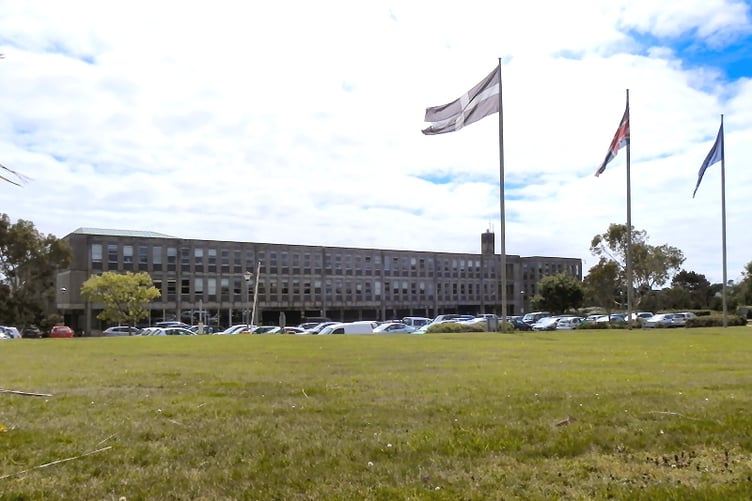
CORNWALL Council is facing a “challenge” and “very difficult decisions” to cut its spending as it faces a debt of £2.360bn within the next five years.
During a finance meeting today (Tuesday, October 13), councillors heard that Cornwall Council is now ranked seventh out of 317 local authorities for the most debt, with a current debt level of £1.571bn (as of March 31, 2026). When compared to statistical neighbours, Cornwall is the highest.
Cornwall sits behind Birmingham (£3.5bn), Leeds (£2.6bn), Woking (£2.2bn), Manchester (£1.7bn), Barking & Dagenham (£1.6bn) and Croydon (£1.59bn).
The meeting heard that Cornwall Council’s long-term capital programme – for its assets, roads, house-building, schools, etc – totals £1.806bn, 49% of which is funded by borrowing. Previous borrowing has led to the £1.571bn debt.
The council’s approved capital financing budget is forecast to increase from £62.678m in 2026/27 to £102m by 2030/31. On current forecasts, capital financing costs would exceed the council’s agreed limit of 9% of net revenue expenditure in 2029/30, rising to 9.5% in 2030/31. For every £10m the council borrows, it currently has to pay back £705,000 in interest a year.
Leah Plummer, head of financial management and advice, told the corporate finance scrutiny committee: “We’ve got a challenge ahead of us to make things more affordable and sustainable while still keeping our assets safe.” Committee members heard that the council will have to make “very difficult decisions across a number of competing priorities”.
Cllr Rowland O’Connor said council officers and decision makers had an “unenviable” task in plotting the savings going forward.
Phil Mason, strategic director for sustainable growth, added: “Essentially what we need to do is decide which bundles of assets we should just get rid of and sell, which bundles of assets are going to drive devolution and therefore we need to be dealing with more quickly in terms of disposal and which assets should we never sell because of social value or significant income streams.”
Cllr Dick Cole warned about the statistics when it comes to Cornwall’s debt compared to other local authorities.
He said: “Of the top ten we were in, a lot of those authorities are a lot smaller than Cornwall, but their debt is a similar or larger amount. Birmingham, at the top, has a population twice the size of Cornwall, so obviously there’s twice the number of houses, etc.



“If we could have stats that are a bit more meaningful in terms of comparable populations it would be helpful and it might actually stop a few hares running as well. Let’s have the full context.”
Cllr Steven Webb added that “we wouldn’t have newer fire engines, newer classrooms, road improvements, social housing, community centres without us having to borrow in some way”.
During the debate, Mr Mason told councillors: “You are going to have to make choices about what we’re not going to continue with. If we had our time again, would we go and buy another Langarth? In this current context, almost certainly we wouldn’t. We would have to find a different way to deliver that.”
Langarth is the council’s large-scale project to deliver around 4,000 homes on land near Truro, creating a new “garden village” roughly the same size as Wadebridge. Total expenditure has reached around £193 million with not one house having been built.
Every council asset, scheme and project will now be reviewed and banded on importance, which will give a “clear view of the council’s highest risk and highest value investments”. A rolling 10-year capital programme is to be developed for 2027/28 and maintained in future years to provide longer-term planning.
Comments
We've recently changed our login process. If you have an account for commenting, you will need to re-register on the login window.
This article has no comments yet. Be the first to leave a comment.